PMAY-G vs PMAY-U: Key Differences & Which One is for You?
Introduction
Last month, I was helping my neighbor Ramesh ji understand why his application for PMAY kept getting rejected. He lives in a small town near the city limits and was confused about whether he should apply for the rural scheme (PMAY-G) or the urban one (PMAY-U). After checking his address and understanding his situation, we realized he had been applying to the wrong scheme all along!
This confusion between PMAY-G and PMAY-U is more common than you think. Both schemes aim to provide affordable housing, but they work differently, have different eligibility criteria, and serve different populations. If you’re planning to apply for Pradhan Mantri Awas Yojana but aren’t sure which category you fall under, this guide will help you understand the differences clearly.
In this article, I’ll explain what makes PMAY-G different from PMAY-U, who should apply for which scheme, and how to avoid the common mistakes that delay applications.
Quick Summary (At A Glance)
| Aspect | PMAY-G (Gramin/Rural) | PMAY-U (Urban) |
|---|---|---|
| Full Name | Pradhan Mantri Awas Yojana – Gramin | Pradhan Mantri Awas Yojana – Urban |
| Target Beneficiaries | Rural poor, houseless families, kutcha house dwellers | Urban poor, slum dwellers, EWS/LIG/MIG categories |
| Area of Implementation | Villages and rural areas | Cities and urban areas |
| Financial Assistance | ₹1.20 lakh (plains), ₹1.30 lakh (hilly/NE regions) | Varies: ₹1 lakh to ₹2.67 lakh depending on component |
| Administering Ministry | Ministry of Rural Development | Ministry of Housing and Urban Affairs |
| Current Extension | Extended till 2028-29 | PMAY-U 2.0 launched till 2029 |
| Latest Target | Additional 2 crore houses (total 4.95 crore by 2029) | 1 crore houses under PMAY-U 2.0 |
| Official Website | pmayg.nic.in | pmaymis.gov.in |
My Real-World Experience with PMAY Confusion
I’ve been helping people with government schemes for over five years now, and one pattern I’ve noticed repeatedly is the confusion between PMAY-G and PMAY-U. Many applicants don’t realize that these are two completely separate schemes with different processes.
Just last year, I came across a family in a peri-urban area (those transition zones between villages and cities) who had applied for PMAY-G because they considered themselves “rural.” But their Gram Panchayat had been converted to a Nagar Panchayat two years ago, making them technically urban. Their application was stuck for months before someone pointed out this issue.
The biggest mistake I see people make is assuming that PMAY is just one scheme. It’s not. The government designed PMAY-G and PMAY-U as two distinct missions with different implementation methods, different verification processes, and even different government departments handling them.
Understanding this difference before you apply can save you months of waiting and unnecessary rejections.
Read More: PM Ujjwala Yojana 2026 – Free Gas Connection Guide
What is PMAY-G vs PMAY-U?
PMAY-G (Pradhan Mantri Awas Yojana – Gramin) is the rural housing component of the Pradhan Mantri Awas Yojana. It focuses on providing pucca houses to families living in kutcha houses or those who are completely houseless in rural India. This scheme was launched in 2016, replacing the earlier Indira Awas Yojana (IAY).
PMAY-G identifies beneficiaries through SECC (Socio-Economic Caste Census) data and Gram Sabha verification. The construction responsibility lies with the beneficiary, and financial assistance is provided in installments as construction progresses.
PMAY-U (Pradhan Mantri Awas Yojana – Urban) targets the urban poor, including slum dwellers and families from Economically Weaker Sections (EWS), Low Income Groups (LIG), and Middle Income Groups (MIG) living in cities and towns. Launched in 2015, it was recently revamped as PMAY-U 2.0 in 2024.
Unlike PMAY-G, PMAY-U offers four different implementation methods: slum redevelopment, credit-linked subsidies for home loans, partnership with private developers, and beneficiary-led individual house construction. This gives urban applicants more flexibility in how they obtain housing.
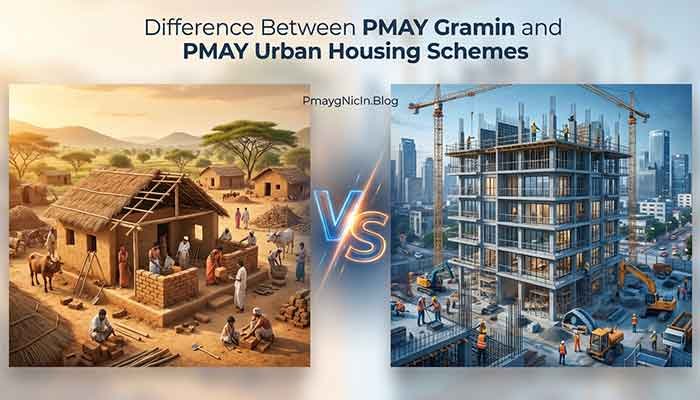
The fundamental difference is simple: PMAY-G is for villages, PMAY-U is for cities. But the execution, benefits, and processes are quite different between the two.
Core Differences Between PMAY-G and PMAY-U
1. Geographic Coverage
PMAY-G: Covers all rural areas of India – villages, hamlets, and areas under Gram Panchayats. If your area comes under a Gram Panchayat administration, you fall under PMAY-G.
PMAY-U: Covers urban areas including cities, towns, municipal corporations, municipal councils, and Nagar Panchayats. Even small towns with urban local bodies are considered urban for this scheme.
Important Note: Some areas are transitioning from rural to urban. Always check your current administrative classification before applying.
2. Beneficiary Selection Process
PMAY-G: Beneficiaries are selected through SECC 2011 data and verified by Gram Sabha. In 2025, a new survey called “Awaas+ 2024” has been launched to identify additional eligible households. The selection is more community-driven.
PMAY-U: Applicants apply online through the PMAY-U portal. Verification is done by Urban Local Bodies (ULBs) through geo-tagging and on-site inspections. The process is more individual application-based.
3. Financial Assistance Structure
PMAY-G:
- ₹1.20 lakh for houses in plain areas
- ₹1.30 lakh for houses in hilly states, difficult areas, and North-Eastern states
- Assistance is provided in three installments based on construction progress
- Cost-sharing: 60:40 between Central and State governments (90:10 for special category states)
PMAY-U:
- Varies by component:
- In-Situ Slum Redevelopment: ₹1 lakh per house
- Credit Linked Subsidy Scheme: Up to ₹2.67 lakh interest subsidy
- Partnership with Private Developers: ₹1.5 lakh per EWS house
- Beneficiary-led Construction: ₹1.5 lakh
- Under PMAY-U 2.0, enhanced subsidies and credit guarantees are available
4. Income-Based Eligibility
PMAY-G: Does NOT have specific income limits. Eligibility is determined by SECC data which looks at multiple deprivation parameters (kutcha house, no adult earning member, etc.). It’s need-based rather than income-based.
PMAY-U: Has clear income categories:
- EWS (Economically Weaker Section): Annual income up to ₹3 lakh
- LIG (Low Income Group): ₹3 lakh to ₹6 lakh
- MIG-I (Middle Income Group I): ₹6 lakh to ₹12 lakh
- MIG-II (Middle Income Group II): ₹12 lakh to ₹18 lakh
Note: Under PMAY-U 2.0 (2024 onwards), MIG eligibility has been revised to up to ₹9 lakh annual income for some components.
5. Implementation Methods
PMAY-G:
- Single approach: Beneficiary builds the house themselves
- No contractor involvement (beneficiaries must self-construct)
- Technical assistance provided through field functionaries
- Houses must include toilet, drinking water connection
PMAY-U:
- Four different verticals:
- In-Situ Slum Redevelopment – Slums are redeveloped on the same land
- Credit Linked Subsidy Scheme (CLSS) – Interest subsidy on home loans
- Affordable Housing in Partnership – Private developers build, 35% reserved for EWS
- Beneficiary-led Individual House Construction – Similar to PMAY-G approach
6. House Ownership Rules
PMAY-G:
- House must be in the name of the female head of household or jointly with male member
- Beneficiary should not own a pucca house anywhere in India
PMAY-U:
- Female ownership or co-ownership mandatory for EWS and LIG categories
- Adult members of the family should not own a pucca house in any part of India
- Only one house per family under the scheme
7. Application Process
PMAY-G:
- No direct online application by beneficiary
- Beneficiaries are identified through surveys and Gram Sabha
- Selected beneficiaries are informed and then complete formalities
- Check status on pmayg.nic.in using registration number
PMAY-U:
- Direct online application at pmaymis.gov.in
- Can also apply through Common Service Centres (CSCs)
- Requires Aadhaar, income proof, identity documents
- Track application using Assessment ID
Eligibility Criteria
PMAY-G Eligibility
Who CAN Apply:
- Families living in kutcha houses (houses with 0, 1, or 2 kutcha walls and kutcha roof)
- Houseless families in rural areas
- Families identified in SECC 2011 with housing deprivation
- Priority: SC/ST families, members, bonded laborers, manual scavengers
- Female-headed households
- Families with disabled members
- New beneficiaries under Awaas+ 2024 survey
Who CANNOT Apply:
- Families owning a pucca house anywhere
- Families who already received IAY/PMAY-G benefits
- Families with any member who owns motorized vehicles (except specific agricultural equipment)
- Families with any member earning more than ₹10,000 per month
- Families with any member paying income tax
- Families residing in urban areas (even if they meet other criteria)
PMAY-U Eligibility
Who CAN Apply:
- Families living in urban areas (cities, towns, municipal areas)
- Economically Weaker Section (EWS) with income up to ₹3 lakh per year
- Low Income Group (LIG) with income ₹3-6 lakh per year
- Middle Income Group (MIG) up to ₹9-18 lakh per year (varies by component)
- Families not owning a pucca house in India
- Slum dwellers in notified slums
- First-time homebuyers
Who CANNOT Apply:
- Families already owning a pucca house
- Those who have availed housing subsidy under any central/state scheme
- Families residing in rural areas
- Those who don’t meet income criteria for their category
- Applications with incorrect or mismatched Aadhaar details
Required Documents
For PMAY-G:
| Document | Why It’s Needed |
|---|---|
| Aadhaar Card | Mandatory for verification and DBT transfer |
| Bank Account Details | For direct transfer of installments |
| Job Card (if MGNREGA worker) | For additional labor support during construction |
| Ration Card | To verify family composition |
| Caste Certificate (if applicable) | For priority selection (SC/ST/members) |
| Disability Certificate (if applicable) | For assistance in construction |
| Convergence certificates | For toilet (SBM), electricity (Saubhagya), LPG (Ujjwala) |
Note: PMAY-G beneficiaries are selected first, then documents are collected. You don’t apply with documents; you provide them after selection.
For PMAY-U:
| Document | Why It’s Needed |
|---|---|
| Aadhaar Card | Mandatory for identity verification |
| Income Proof | To determine EWS/LIG/MIG category |
| Bank Account & IFSC Details | For subsidy transfer |
| Property Documents (if any) | To verify non-ownership |
| Ration Card | For family verification |
| Caste Certificate (if applicable) | For reserved category benefits |
| Passport-size Photographs | For application processing |
| Address Proof | To confirm urban residence |
| Self-declaration of non-ownership | Legal requirement |
How to Check Eligibility and Apply
For PMAY-G (Step-by-Step)
Step 1: Check if Your Area is Rural Visit your Gram Panchayat office or check online if your village is under Gram Panchayat administration. If yes, you’re eligible to be considered for PMAY-G.
Step 2: Verify SECC Selection or New Survey
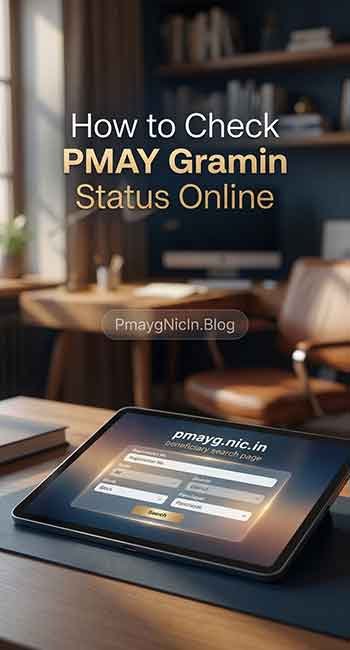
- Visit pmayg.nic.in
- Go to “Stakeholders” > “IAY/PMAY-G Beneficiary”
- Enter your registration number (if you have one)
- OR check if you’re in the SECC 2011 list
- New survey through Awaas+ 2024 app is ongoing in 2025-26
Step 3: Wait for Gram Sabha Verification If identified in surveys, your name will be verified in Gram Sabha meetings. Local officials will inform you.
Step 4: Complete Formalities Once selected:
- Provide Aadhaar and bank details
- Sign necessary forms
- Attend orientation about house construction requirements
Step 5: Start Construction
- Receive first installment (₹40,000 after sanction)
- Complete plinth level → Get second installment (₹50,000)
- Complete roof level → Get final installment (₹30,000 for plains, ₹40,000 for hilly areas)
For PMAY-U (Step-by-Step)
Step 1: Visit PMAY-U Portal Go to pmaymis.gov.in and click on “Citizen Assessment”
Step 2: Choose Your Category Select between:
- “Slum Dwellers” (if living in notified slums)
- “Benefits under 3 components” (for other categories)
Step 3: Fill Application Form
- Enter Aadhaar number
- Provide personal details (name, father’s name, age)
- Enter family details
- Provide income information
- Upload required documents
- Enter bank account details
Step 4: Submit and Note Assessment ID After submission, you’ll receive an Assessment ID. Save this – you’ll need it to track your application.
Step 5: Track Your Application
- Go to “Track Your Assessment Status”
- Enter Assessment ID or Aadhaar number
- Check approval status
Step 6: If Approved – Choose Your Path Depending on your component:
- CLSS: Apply for home loan through approved banks
- Slum Redevelopment: Work with implementing agency
- Private Partnership: Select from available projects
- Individual Construction: Receive assistance in installments
Common Problems Users Face & Solutions
Problem 1: Confusion About Urban vs Rural Classification
Issue: Many people living in peri-urban areas or small towns don’t know which scheme applies to them.
Solution:
- Check your address’s administrative classification
- Visit your local Gram Panchayat or Municipal office
- Areas under Gram Panchayat = PMAY-G
- Areas under Municipal Corporation/Council/Nagar Panchayat = PMAY-U
- If your area recently changed from rural to urban, apply for PMAY-U
Problem 2: PMAY-G Beneficiaries Not Receiving Installments
Issue: Selected beneficiaries complete construction stages but don’t receive subsequent installments on time.
Solution:
- Ensure Aadhaar is linked with bank account and mobile number
- Get geo-tagged photographs at each construction stage
- Submit completion certificates to Block Development Officer promptly
- Check payment status regularly on pmayg.nic.in
- Follow up with district Rural Development office if delayed beyond 30 days
Problem 3: PMAY-U Application Stuck in Pending Status
Issue: Application shows “Pending” for months without any progress.
Solution:
- Most common cause: Aadhaar mismatch (name spelling, date of birth)
- Get Aadhaar corrected first if there are discrepancies
- Verify all documents uploaded are clear and readable
- Contact your Urban Local Body (Municipality) for physical verification status
- If stuck for more than 90 days, file RTI or escalate to district authority
Problem 4: Getting Rejected Despite Meeting Criteria
Issue: Application rejected even when applicant believes they meet all requirements.
Solution:
- Common rejection reasons:
- Property ownership discovered in family member’s name
- Income exceeds category limits
- Previous housing subsidy availed by family
- Request detailed rejection reason from implementing agency
- If rejection is incorrect, file appeal with supporting documents
- For PMAY-G, approach Gram Sabha and district officials
- For PMAY-U, submit grievance on PMAY portal or contact ULB
Problem 5: Don’t Have SECC Data for PMAY-G
Issue: Family believes they’re eligible for PMAY-G but weren’t in SECC 2011 survey.
Solution:
- Good news: New survey “Awaas+ 2024” is being conducted
- Download Awaas+ 2024 mobile app or contact your Gram Panchayat
- Participate in the self-survey or assisted survey
- This will identify new eligible households for PMAY-G
- Stay in touch with local authorities for survey schedules
Frequently Asked Questions (FAQs)
No, you cannot apply for both. You must apply for the scheme that matches your residential area. If you live in a rural area, only PMAY-G applies. If you’re in an urban area, only PMAY-U is relevant. Applying to both will result in rejection of both applications.
In PMAY-G, the house must be in the name of the female head of the household or jointly with a male member. In PMAY-U, for EWS and LIG categories, female ownership or co-ownership is mandatory. Both schemes prioritize women’s empowerment through property ownership.
PMAY-G approval depends on SECC verification and Gram Sabha meetings, typically taking 2-4 months after identification. PMAY-U online applications usually take 3-6 months, depending on document verification and physical inspection by Urban Local Bodies. Aadhaar-related issues are the most common cause of delays.
Yes, owning land does not disqualify you. Both PMAY-G and PMAY-U are concerned with whether you own a “pucca house.” If you own vacant land or land with a kutcha structure, you can still be eligible. However, you must not own any pucca house anywhere in India in your or your family member’s name.
PMAY-U 2.0 is the revamped version of the urban housing scheme launched in 2024. It doesn’t completely replace the old scheme but is an extension with updated rules, better monitoring, and enhanced focus on middle-income groups. It runs till 2029 with a target of 1 crore houses. If you’re applying now, you’re applying under PMAY-U 2.0 framework.
Important Disclaimer
This article provides informational guidance based on available government notifications and official sources. PMAY-G and PMAY-U are government schemes with policies that may be updated from time to time.
I am not a government official, and this content is meant to help you understand the schemes better. Always verify the latest information from official sources:
- PMAY-G Official Website: pmayg.nic.in
- PMAY-U Official Website: pmaymis.gov.in
- Ministry of Rural Development: rural.nic.in
- Ministry of Housing and Urban Affairs: mohua.gov.in
For application-specific queries, contact your local:
- For PMAY-G: Block Development Officer or District Rural Development Office
- For PMAY-U: Urban Local Body (Municipality/Municipal Corporation)
Eligibility criteria, benefit amounts, and procedures can vary by state implementation. Always check with local implementing authorities before making decisions.
Conclusion
Understanding the difference between PMAY-G and PMAY-U is crucial before you start your housing application journey. The key distinction is simple: PMAY-G serves rural areas through community-based selection, while PMAY-U serves urban areas through individual online applications. Both schemes aim to provide housing for all, but they work through different processes, different government departments, and different benefit structures.
If you’re in a village under Gram Panchayat, focus on PMAY-G – wait for surveys, stay connected with your Gram Sabha, and ensure your Aadhaar and bank details are ready. If you’re in an urban area, PMAY-U is your path – prepare your documents, verify your income category, and apply online at the earliest.
Both schemes have been extended till 2028-29, giving millions more families the opportunity to own a pucca house. Whether you’re building in a village or buying in a city, understanding which PMAY scheme applies to you is the first step toward getting your dream home.
Have questions about PMAY-G vs PMAY-U? Drop a comment below or share this guide with someone who might be confused about these schemes. Let’s help more families get the housing assistance they deserve!