PMAYG e-KYC: Complete Guide to Aadhaar Seeding (2026)
I remember receiving a worried call from my neighbor, Ramesh, last month. He had been approved for PMAY-G housing assistance, but his payment was stuck. After some digging, we discovered the issue: his Aadhaar wasn’t linked with the PMAY-G system. The e-KYC wasn’t done.
If you’re reading this, you’re probably facing something similar. Maybe your installment is delayed, or you’re preparing your application and want to avoid complications. I’ve worked with dozens of beneficiaries over the years, and I can tell you that PMAYG e-KYC issues are one of the most common reasons for payment delays.
This guide will walk you through the entire PMAYG e-KYC process in simple language, explain why it’s necessary, and help you troubleshoot common problems. By the end, you’ll know exactly what to do.
Quick Summary (At A Glance)
| Scheme Name | Pradhan Mantri Awas Yojana – Gramin (PMAY-G) |
| Purpose of e-KYC | Link Aadhaar with beneficiary records to enable Direct Benefit Transfer (DBT) |
| Key Benefit | Prevents payment delays and ensures funds reach you directly |
| Who Must Do It | All PMAY-G approved beneficiaries |
| Official Website | pmayg.nic.in |
| Latest Update | As of 2026, e-KYC is mandatory for all new and pending beneficiaries |
My Real-World Experience with PMAYG e-KYC
Over the past few years, I’ve helped many rural families navigate the PMAY-G process. One recurring problem I’ve noticed is incomplete or incorrect e-KYC details. In most cases, beneficiaries weren’t even aware that their Aadhaar needed to be linked.
Last year, I helped a group of 15 beneficiaries in my village whose second installments had been pending for over three months. When we checked their accounts on the PMAY-G portal, we found that none of them had completed e-KYC properly. Some had incorrect Aadhaar numbers in the system, and others had never seeded their Aadhaar at all.
After we got their e-KYC corrected through the block office and CSC centers, their payments were released within two weeks. This taught me that while e-KYC seems like a small technical step, it’s actually the single most important factor in ensuring timely payments.
Read More: PM Kisan New Registration 2026 | Step-by-Step Guide
What is PMAYG e-KYC Process?
PMAYG e-KYC, or electronic Know Your Customer, is the process of linking your Aadhaar card with your PMAY-G beneficiary record. Think of it as a digital verification that confirms your identity in the government database.
The government uses this to make sure that housing assistance money goes directly to the right person’s bank account. Without proper e-KYC, the system can’t verify who you are, and your payment gets stuck.
In simple terms, e-KYC connects three things: your Aadhaar number, your bank account, and your PMAY-G registration. When all three are properly linked, funds flow smoothly through Direct Benefit Transfer (DBT).
Eligibility Criteria for PMAYG e-KYC
Before starting the e-KYC process, make sure you meet these basic requirements:
- You must be an approved PMAY-G beneficiary (your name should appear in the beneficiary list)
- You must have a valid Aadhaar card in your name
- Your Aadhaar must be active and not suspended
- Your bank account must be linked with your Aadhaar (NPR seeding should be done)
- Your mobile number should be registered with your Aadhaar for OTP verification
Who is NOT eligible:
- People whose PMAY-G application is still pending or rejected
- Those who don’t have an Aadhaar card
- Beneficiaries whose Aadhaar details don’t match their bank account or PMAY-G records
Required Documents for PMAYG e-KYC
Keep these documents ready before you visit your CSC or block office:
| Document | Purpose | Required |
| Aadhaar Card (original) | For identity verification and biometric authentication | Mandatory |
| Bank Passbook or Statement | To verify bank account details linked with Aadhaar | Mandatory |
| PMAY-G Registration Number | To access your beneficiary record in the system | Mandatory |
| Mobile Number (Aadhaar-linked) | For OTP verification during the process | Mandatory |
| SECC/BPL Certificate | May be asked to verify eligibility in some cases | Optional |
How to Check and Complete PMAYG e-KYC (Step-by-Step)
There are two main ways to complete your PMAYG e-KYC: online through the portal or offline at a CSC/block office. I’ll explain both methods.
Method 1: Check e-KYC Status Online
First, let’s see if your e-KYC is already done or pending:
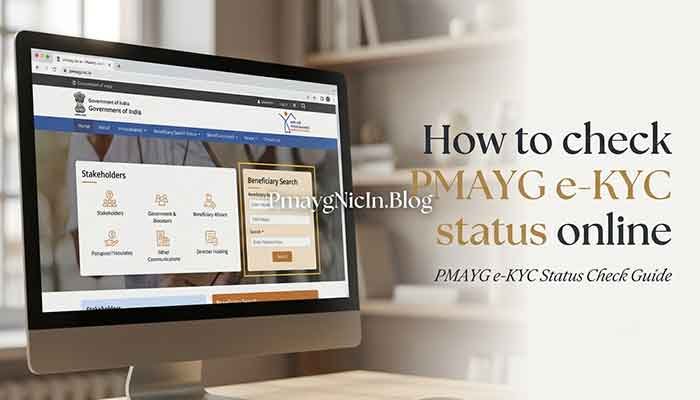
- Visit the official PMAY-G website: pmayg.nic.in
- Look for the ‘Stakeholders’ section on the homepage
- Click on ‘IAY/PMAYG Beneficiary’ option
- Enter your PMAY-G Registration Number or Aadhaar number
- Click ‘Submit’ to view your beneficiary details
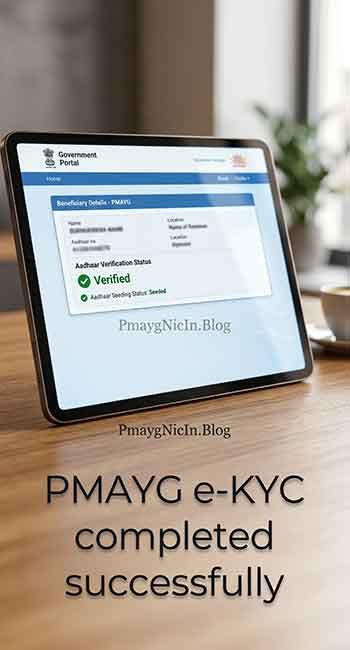
- Check the ‘Aadhaar Verification Status’ column – if it shows ‘Verified’ or ‘Seeded’, your e-KYC is complete
Method 2: Complete e-KYC at CSC Center or Block Office
If your e-KYC is pending or shows ‘Not Verified’, follow these steps:
- Visit your nearest Common Service Center (CSC) or Block Development Office
- Carry all required documents (Aadhaar card, bank passbook, PMAY-G registration number)
- Request the operator to update your e-KYC details in the PMAY-G portal
- The operator will enter your Aadhaar number and verify it through biometric authentication (fingerprint or iris scan)
- An OTP will be sent to your Aadhaar-linked mobile number – share this with the operator
- Once verified, your Aadhaar will be seeded with your PMAY-G record
- Collect a receipt or acknowledgment slip for your records
The process usually takes 10-15 minutes if all your documents are correct. After e-KYC is complete, wait for 2-3 days and then check the status online again to confirm.
Method 3: Using Awas App (For Monitoring Only)
The Awas mobile app allows you to monitor your PMAY-G application status, but you cannot complete e-KYC directly through the app. However, it’s useful for tracking whether your e-KYC has been updated after visiting the CSC.
- Download ‘Awas’ app from Google Play Store
- Enter your PMAY-G registration number
- View your beneficiary profile and check Aadhaar status
Common Problems Users Face & Solutions
Based on my experience helping beneficiaries, here are the most common e-KYC problems and how to solve them:
Problem 1: Aadhaar number doesn’t match records
This happens when the name or details on your Aadhaar card don’t exactly match what’s written in the PMAY-G system. Even small spelling differences can cause this.
Solution: Visit your block office with both your Aadhaar card and PMAY-G documents. Ask them to correct the mismatch in the system. If your Aadhaar details are wrong, you’ll need to update them at an Aadhaar center first.
Problem 2: OTP not received during verification
If your mobile number isn’t linked with Aadhaar, you won’t get the OTP.
Solution: First, check if your mobile number is registered with Aadhaar by visiting uidai.gov.in or calling 1947. If not linked, visit an Aadhaar center to update your mobile number. This usually takes 1-2 days to activate.
Problem 3: Biometric authentication fails
This often happens with people people or manual laborers whose fingerprints are worn out.
Solution: Try iris scan instead of fingerprint. If that also doesn’t work, you can use the exception handling process where an authorized officer manually verifies your identity. Ask the CSC operator about this option.
Problem 4: Bank account not Aadhaar-seeded
Even if your PMAY-G e-KYC is complete, if your bank account isn’t linked with Aadhaar, payments will still fail.
Solution: Visit your bank branch with your Aadhaar card and passbook. Submit an Aadhaar seeding request form. Most banks complete this within 24-48 hours. You can verify if it’s done by checking NPCI’s NACH portal or asking at your bank.
Problem 5: ‘e-KYC pending’ status not changing
Sometimes after completing e-KYC at CSC, the online status doesn’t update immediately.
Solution: Wait for 3-5 working days for the system to update. If it still shows pending after a week, contact your block office with your acknowledgment receipt. They can manually check and push the update from their end.
Frequently Asked Questions (FAQs)
Yes, absolutely. Without completing e-KYC, your payments cannot be processed through DBT. The government made this mandatory to prevent fraud and ensure money reaches the right beneficiary.
Once your e-KYC status shows ‘Verified’, payments are usually processed in the next disbursement cycle. This typically takes 15-30 days depending on fund availability at the state level.
No, Aadhaar seeding requires biometric authentication which can only be done at authorized centers like CSCs or block offices. However, you can check your e-KYC status online from home.
You must get your Aadhaar corrected first at an Aadhaar Enrollment Center. Once updated, wait 7-10 days for the changes to reflect in the UIDAI database, then proceed with PMAY-G e-KYC.
CSC centers may charge a nominal service fee (usually Rs. 20-50) for Aadhaar verification services. However, the actual e-KYC process itself is free. If anyone asks for excessive fees, report to your block office.
Important Disclaimer
This article is purely informational and based on my practical experience helping PMAY-G beneficiaries over the years. I am not a government official, and this website (Pmayg Nic In.blog) is an independent information portal, not affiliated with any government department.
While I’ve made every effort to provide accurate information, government procedures and portal features can change. Always verify the latest process and requirements from the official PMAY-G website (pmayg.nic.in) or your local block office before taking action.
If you face any technical issues or need official assistance, contact the PMAY-G helpline at 1800-11-6446 (toll-free) or email support-pmayg@gov.in.
Conclusion
Completing your PMAYG e-KYC is not complicated once you know the right steps. The key is making sure your Aadhaar, bank account, and PMAY-G registration are all properly linked. From my experience, most delays happen because beneficiaries don’t realize there’s a problem until their payment is stuck.
Don’t wait for a problem to arise. Check your e-KYC status today, and if it’s pending, visit your nearest CSC or block office with the required documents. The entire process takes less than an hour, and it ensures your housing assistance reaches you without delays.
If you found this guide helpful, please share it with other PMAY-G beneficiaries in your area. And if you have any questions or face issues during the process, feel free to ask in the comments or reach out to your block office for official guidance.
Remember, PMAYG e-KYC is your gateway to timely payments. Take that small step today for a smoother journey toward your pucca house dream.